This article was generated with AI assistance from cited sources and has not been individually reviewed by an editor.
Status note: facts stated as at 30 August 2026. Administration is a moving target; we cite primary records (Companies House, The London Gazette, the administrator’s own statements) wherever they exist.
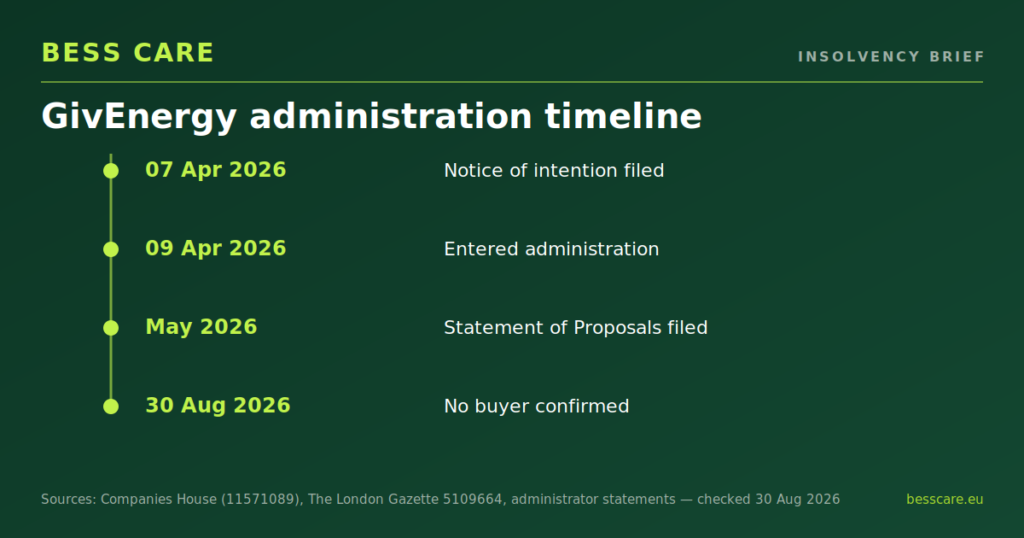
On 9 April 2026, GivEnergy Ltd — one of the UK’s biggest home battery brands — entered administration. The notice had been filed two days earlier, on 7 April; the appointment was published in The London Gazette (notice 5109664) the following day. The administrator is Christopher Brooksbank of CB Business Recovery, appointed through the High Court of Justice in Leeds.
The administrator’s first statement was blunt: the company has ceased to trade, all employees have been made redundant, and GivEnergy Ltd will not honour further hardware warranties, user support or software support. Owners, it said, should contact their installer first.
That is the part most coverage led with. The more useful question is what it means in practice — and that starts with a distinction almost nobody made in the first week.
The appointment covers GivEnergy Ltd only — company number 11571089, the entity that designed, built and, on paper, warranted the hardware. The administrator explicitly listed the group entities not covered, including GivEnergy Software Ltd (company 14899764) — the separate company that runs the app and the portal.
This is the detail that changes what owners should expect:
A brand, it turns out, was several companies. The one that owed you the warranty was allowed to fail on its own.
Roughly in order of cost and effort:
One more honest note: the trade press does not agree on how many staff lost their jobs — figures of 35 and 28 both appear in coverage, while 74 is the year-end headcount recorded in the 2024 annual report, not a redundancy figure. We report the inconsistency rather than pick a number; the administrator’s own filings are the authoritative record. We hold ourselves to the same sourcing standard we ask of manufacturers.
The 2024 accounts filed at Companies House show turnover of about £50.3m, an operating loss of about £6.5m (from a £6.2m operating profit the prior year), a post-tax loss of about £5.4m, and cash reserves of about £41,470 at year end. The accounts attribute the deterioration to leadership failures and to not responding to sharp price cuts from foreign competitors.
The administrator’s Statement of Proposals, filed at Companies House in May 2026, goes further: unsecured creditors are owed more than £17m. Of the roughly £11.1m in stock on the books, the bulk is recorded as transferred to a related company; what remained, about £925,000, was valued in the insolvency at £114,711. A creditors’ meeting result was filed in June. As at 30 August 2026, no buyer has been confirmed. A going-concern sale could restore some support; an asset sale would not.
GivEnergy’s warranty was, on paper, a strong one. The paper was not the asset; the company behind the paper was.
This is the question worth adding to any purchase of long-lived energy equipment: which legal entity stands behind the warranty, and how long is it likely to exist? It is a different question from “how good is the product” and “how long is the warranty,” and it is answerable — an afternoon on a company register tells you more about the next ten years than a spec sheet does.
The same discipline applies to service arrangements: who holds the obligation, what happens to your records if they exit, and whether the party you actually deal with is the party that owes you anything. Owners who asked those questions before April 2026 are having a much better summer than those who did not.
The hardware manufacturer, GivEnergy Ltd, is not: it entered administration on 9 April 2026, has ceased trading and made its staff redundant. The wider group continues to trade, and GivEnergy Software Ltd — which runs the app and portal — is not in administration. Administration is not liquidation; the final outcome (sale or wind-down) had not been decided as at 30 August 2026.
A direct claim against GivEnergy Ltd is unlikely to be met: the administrator has said no further hardware warranties will be honoured, and the Statement of Proposals records over £17m owed to unsecured creditors against little realisable stock. Your realistic routes are your installer, an insurance-backed guarantee if you have one, and Section 75 if you paid by credit card. Verify each before relying on it; this article is not legal advice.
Not because of the administration — the app is run by a separate, solvent company. And regardless of the cloud, your system’s core functions run locally on the device.
No. Installed hardware keeps working on local control. Spend your effort on documentation and on establishing a support route (installer or independent engineer), not on replacing functioning equipment.
Only with a written answer to one question: who diagnoses a fault, supplies parts, pays for labour and honours the warranty. A discount is not that answer.
No updates or corrections as at 30 August 2026.
Sources: Companies House filing history and insolvency record for GivEnergy Ltd (11571089); The London Gazette notice 5109664; administrator statements via CB Business Recovery (16 April 2026) and the Statement of Proposals (filed May 2026); Energy Storage Association FAQ for GivEnergy owners; GivEnergy Ltd 2024 annual accounts. All checked 30 August 2026. This article is information, not legal advice.