

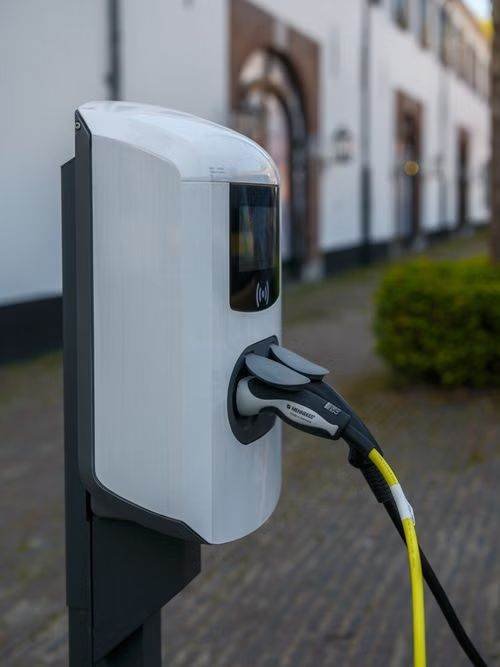
90% of homes do not need 22 kW. Here is the decision tree that gets you to the right charger in four questions — and the reason the charger’s brain matters more than its muscles.
Start with the only number that matters: how much energy you actually need to replace overnight. The average Belgian EV driver covers 40–60 km a day — 8 to 12 kWh. An 11 kW three-phase charger replaces that in about an hour; even a 7.4 kW single-phase unit does it before midnight. The 22 kW unit charging your car by 19:30 and then sitting idle is not faster in any way that touches your life — it just costs €200–€400 more and, in Belgium, risks pushing you into a higher capacity-tariff band if it runs at the wrong moment.
Question one: what does your connection allow? Much of Flemish housing stock is single-phase 40A, which caps you at 7.4 kW without a costly upgrade. Check before you shop. Question two: do you have solar? If yes, a charger with PV-surplus mode charges the car from the roof’s excess — free kilometres all summer. Question three: are you on, or considering, a dynamic tariff? Then scheduling intelligence is worth more than any hardware spec: charging 2,800 kWh a year in cheap quarter-hours saves €150–€310 annually against unmanaged charging. Question four: is bidirectional in your future? Vehicle-to-home is legal in Belgium, but grid-operator rules decide the how; buying “V2H-ready” hardware today only makes sense if the charger documents the pathway.
Now the part the spec sheets bury: the features that actually change your bill. Tariff-aware scheduling with a departure-time guarantee (the car must be full by 07:00 regardless). Load balancing that respects your main fuse when the heat pump starts. An open protocol — OCPP — so a future energy manager can talk to the charger. And a published firmware support horizon: a charger is a computer on your wall, and five years of updates should be the minimum ask.
What to ignore: app store ratings (they measure onboarding, not charging), peak power marketing, and “free” chargers bundled with supplier contracts that lock your tariff for three years — the most expensive free hardware in the market.
The integration point: if a battery is in your plan, buy the charger that talks to it. Charger-battery coordination — solar to the car first, then the home battery, then the grid — is where the next €200 a year sits. Our selection table scores exactly these integrations.
Method: driving-pattern data from Belgian mobility statistics, quarter-hour price analysis 2025–2026, charger feature verification against vendor documentation.